

Inside the Discord "Sweatshops" Running the Internet ✂️
Behind-the-scenes of our latest investigation


Hey, Neighbor,
This week, we released our latest multi-month investigation—weaving together “psyops,” algorithmic manipulation, and so-called “clipping” into a story that ultimately coalesces around the topic of media literacy.
You can watch the full doc here.
Scroll on for three behind-the-scenes observations. But before you do: A big shout-out to our very own Cris Campos for his work on this piece, as we continue to level up our production process.
I’m always blown away by what a small team of highly-motivated individuals can pull off when we set our minds to it. Sky’s the limit.
— NGL

3️⃣ Things I’m Thinking: Less is More
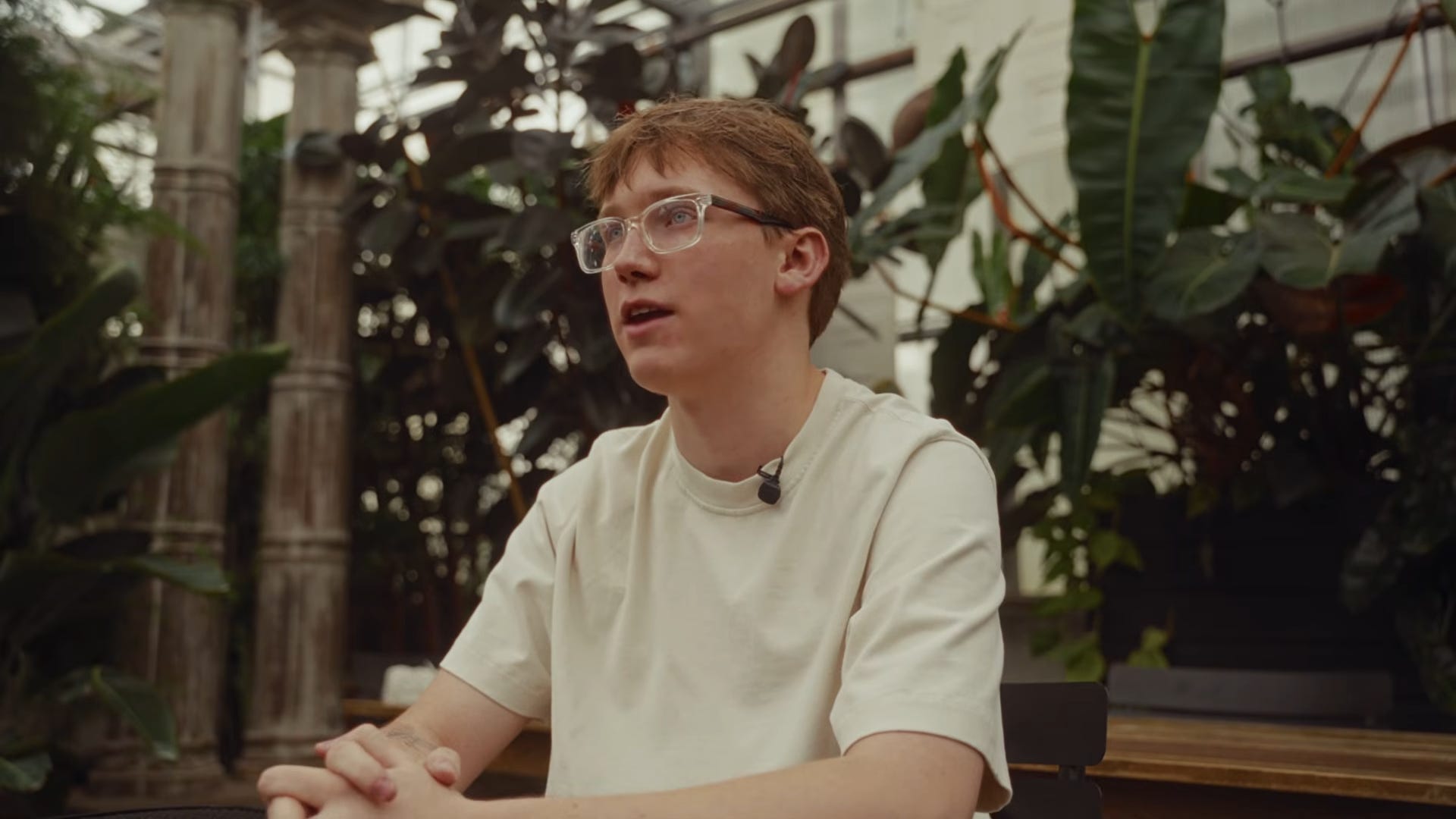
1. Talking to humans is one of the last moats we have against AI. These days, producing original interviews is not logical.
It is costly. It is time-consuming. Remote recording tools like Riverside (which we use) or even Google Meet are highly-effective.
But it’s also real. Past just putting in the effort, I find that in-person interviews reveal a lot more about someone. For the journalist, you’re forced to build trust with your subject, fast. For the subject, you can’t hide behind a screen (or carefully-crafted notes) when you’re mere feet away from the person interviewing you.
A lot of thought goes into how we construct a story, too. As we prepped for our interview with Evan Stanfield—a twenty-year-old college dropout and clipping agency founder—we felt placing him among nature would be visually striking, a direct contrast with the highly-synthetic conversation around modern marketing tactics.
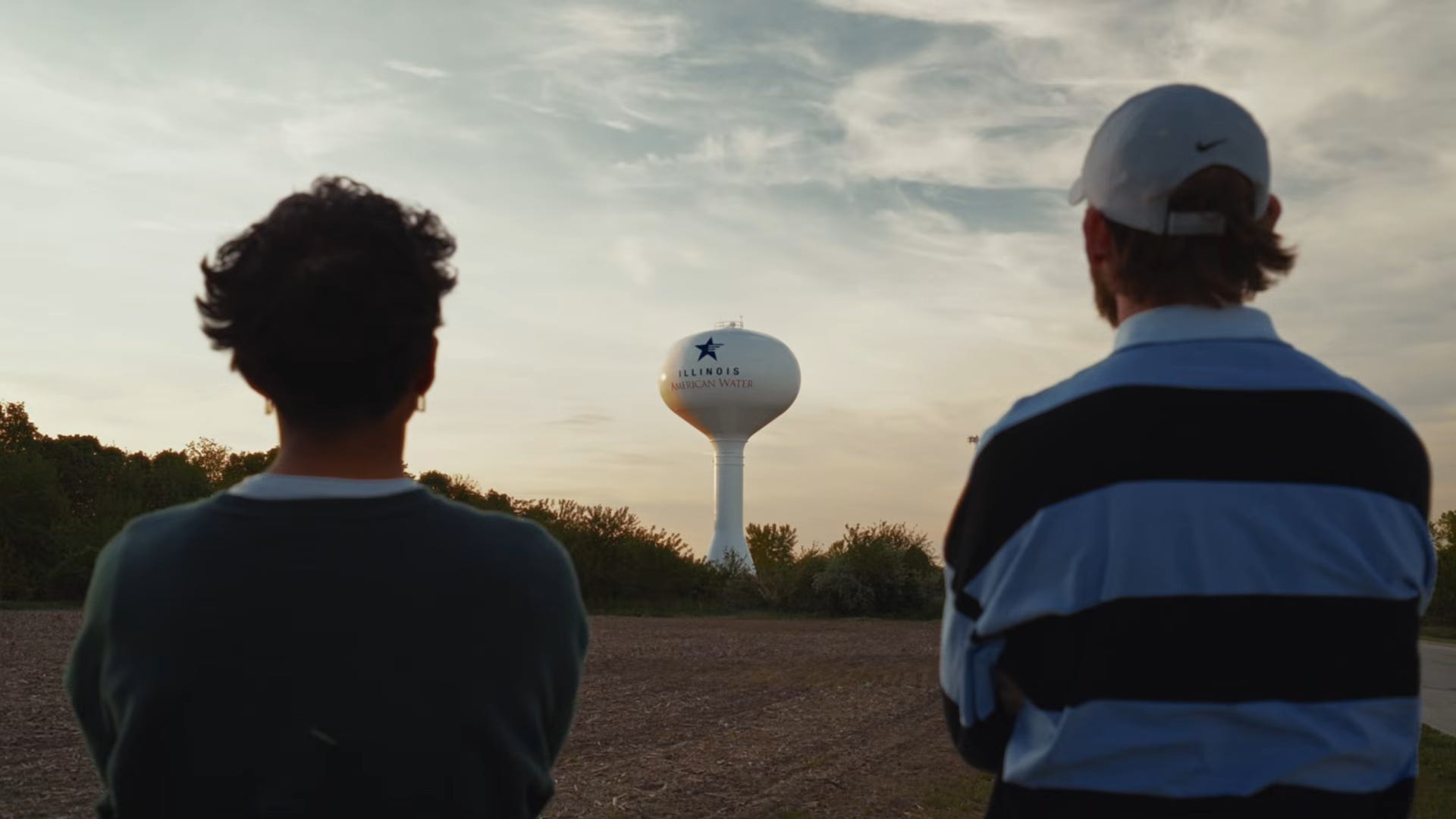
The only issue? Given Kansas City is an eight-hour drive, we really only had one shot. If we filmed outside and the weather didn’t cooperate, we were cooked.
Enter: Family Tree Nursery. A friend in Kansas City mentioned the family-owned plant store’s beloved greenhouse cafe; several cold emails and calls later, we had our setting.
There’s a reason movies have full-time producers. For a team of two, wrangling this kind of stuff (while writing, filming, and editing the story itself) adds an entire second meal onto the plate.
But now that we’re on this side of the project, I wouldn’t have done it any other way. With the rise of AI—and the flattening of “faceless” content—that friction and leg work may be the only moat we as creatives have left.1
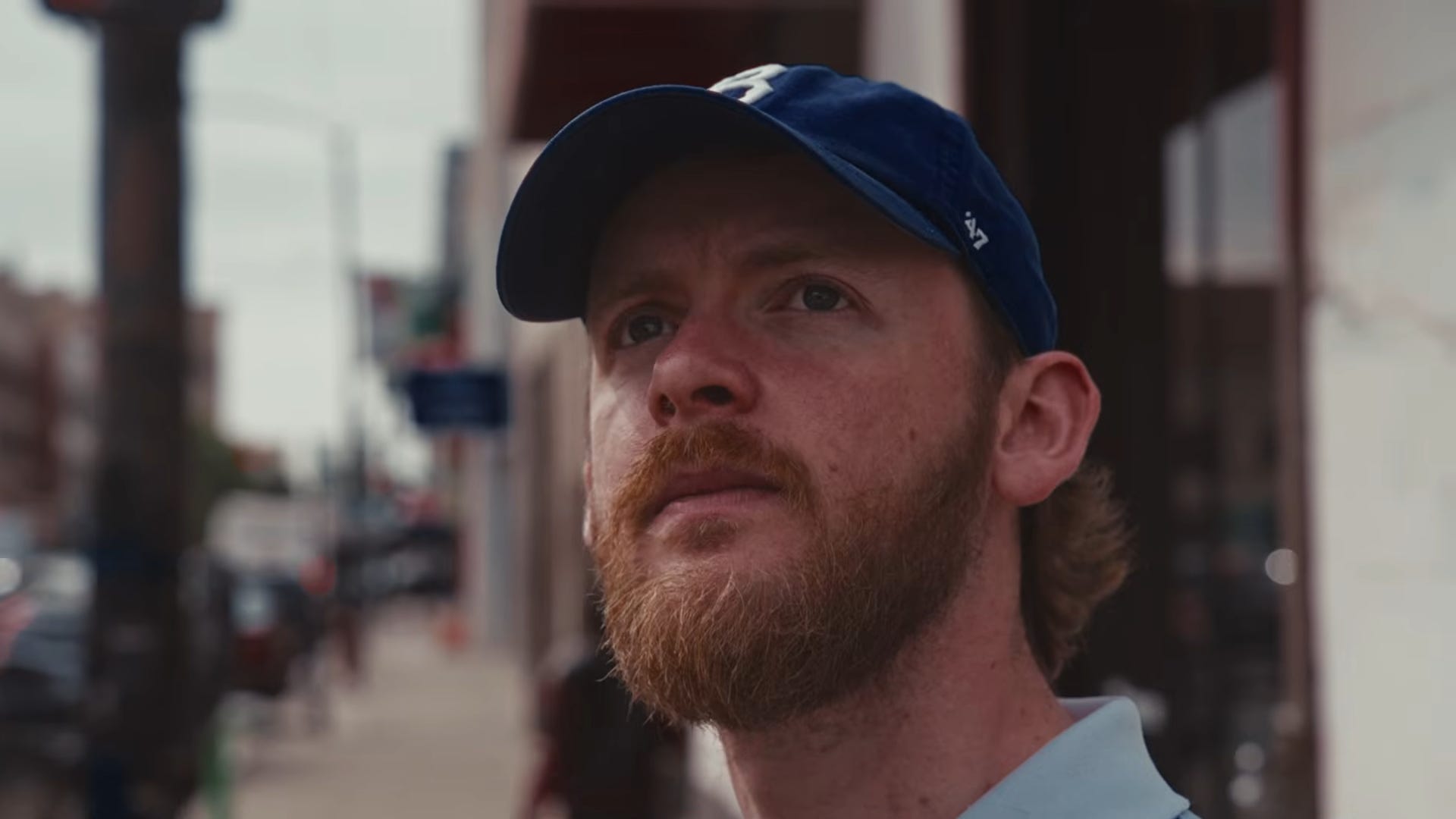
2. Finding your voice takes time. I’ve been editing videos and uploading them to the Internet since high school (if you’re really bored, you can watch some of them here). Our whole team has.
Still, at some point in (and after) J-school, I realized that my writing was my calling card. As a medium, it creates the most depth; as an introvert, it allowed me to bury myself in the doc. No matter how maddeningly frustrating the process can be sometimes, writing is my chosen craft, and everything else—podcast production, video editing, and product design—became a secondary focus.
Problem is, it’s near-impossible to cut through the noise these days without acting as front-facing “talent” in some capacity. So how does a camera-shy writer with little-to-no acting skills show up on YouTube?
It took all of last year (and into 2026) to find the right voice, but weirdly enough, I’ve become much more comfortable slipping into the costume of “Journalist Who Takes Himself Way Too Seriously” than I am of being my true self in front of a camera. In turn, our overarching tone—real interviews, with a splash of mockumentary mixed in—has come into focus.
Long story short: We’ve found a voice and direction we really like, and you can expect us to continue putting out more work in this lane moving forward.
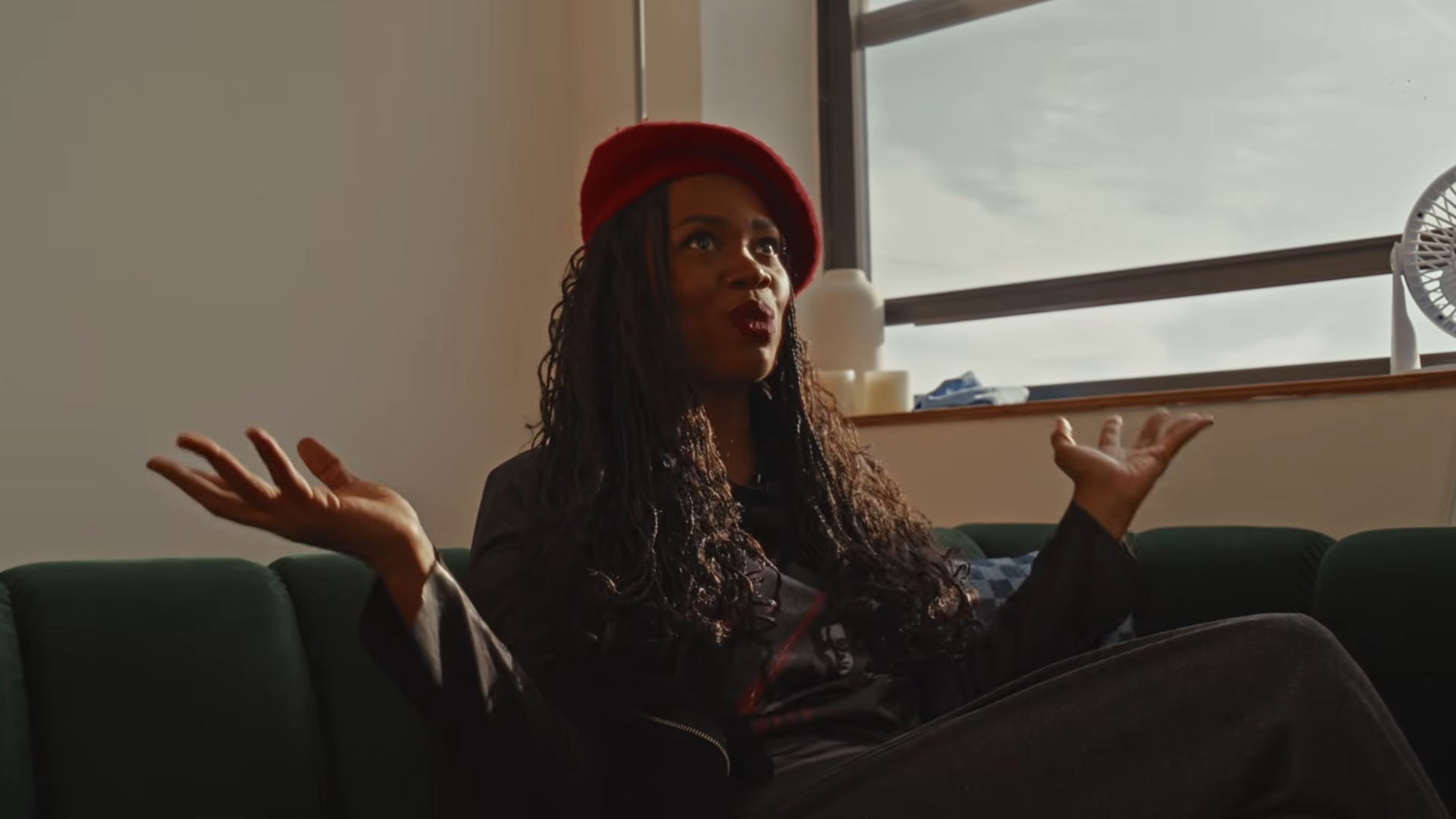
3. Sometimes, less is more. These days, our capacity for watching longer and longer videos has only increased. Twenty minutes feels like the baseline, not an outlier.
Yet I still find it difficult to pack every idea into this extended runtime. I used to hate when artists say the ending is up to your interpretation, but the more time that passes, the more I’ve come to appreciate the art of less is more.
For example: As I went down the rabbit hole, I began to realize just how many clippers credit the misogynistic provocateur Andrew Tate as the “godfather” of clipping, referencing his “Hustlers University” referral scheme where editors got a commission for every “student” they converted. Some clippers would even brag about generating millions of views for Tate, using it as a “portfolio” of sorts.
These clippers would leave out an important part of the story—that the proliferation of Tate’s clips directly correlated with a sharp rise in violence against women, as The New Yorker recently investigated in explosive fashion.2
Towards the end of post-production, I almost rewrote the conclusion to include further commentary on this dynamic. But I decided against injecting too many big ideas, leaving the central focus on media literacy instead.
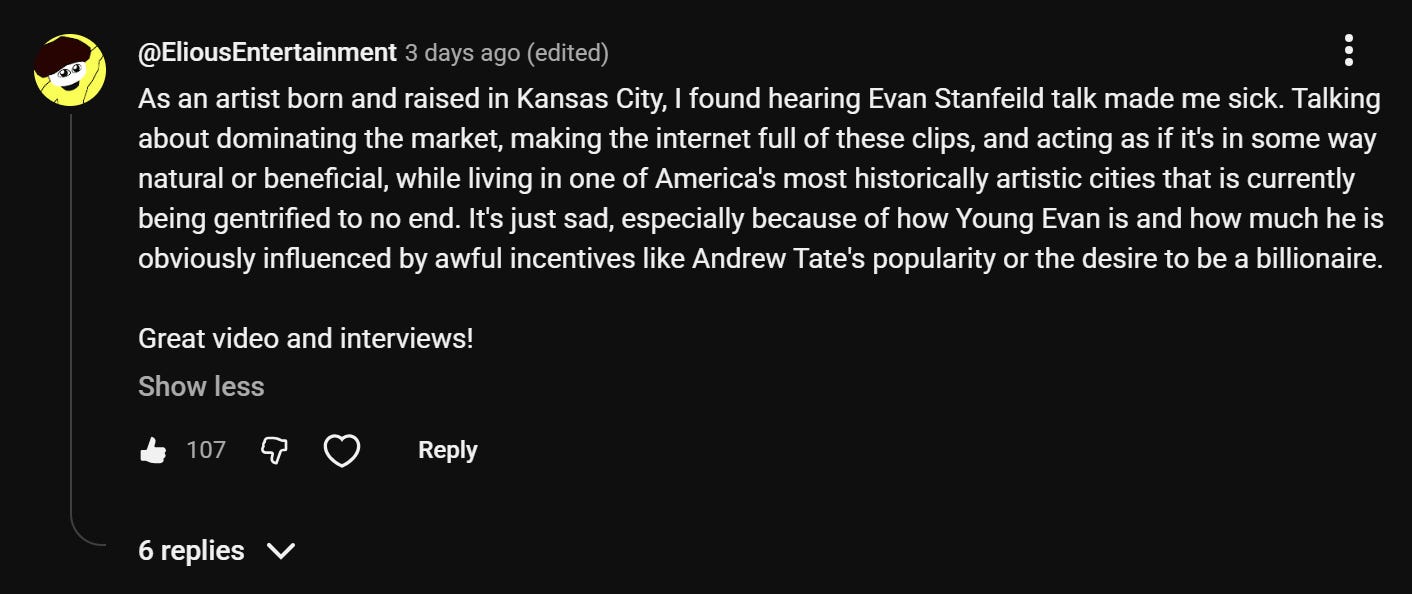
As it turns out, though, your audience is a lot smarter than you may sometimes give them credit for. While I don’t necessarily agree with the entire sentiment in the comment above—and I like to think we portrayed all subjects in the doc in a fair light—it’s refreshing to see our work engender deeper reflections on the core themes we set out to cover.
If you ever feel the urge to over-yap, just remember that everything you release to the public is a two-way conversation. The audience helps create the meaning of a piece, too.
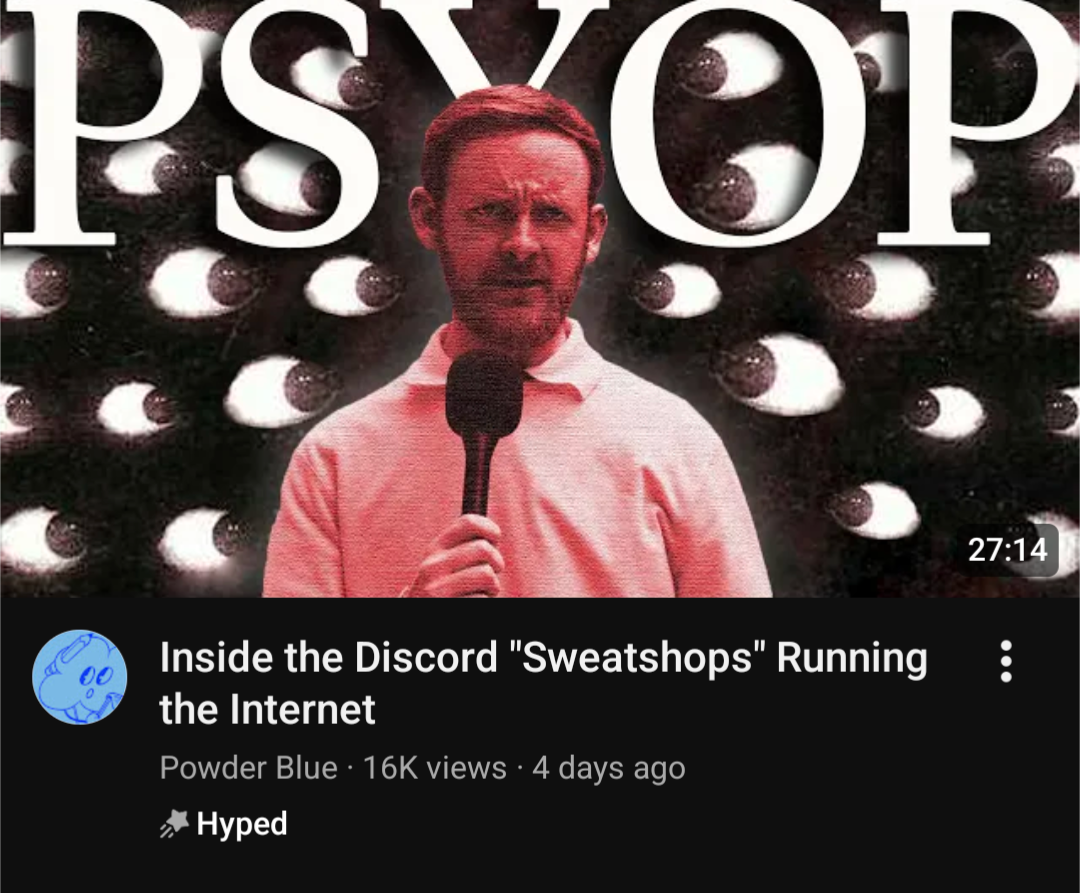
If you enjoyed our new video, make sure to click the “HYPE” badge below it!
We’re currently closing in on the YouTube Top 100 Hype Charts. If we crack the leaderboard today, YouTube pushes this investigation to the entire country. And since we’re a smaller channel, your hype vote goes a long way.
Let’s show what a neighborhood full of real humans can do…no “psyop” needed (:
1️⃣ Update From The Stu: Revealing Thursday’s Lineup!


This Thursday, we’re teaming up with acclaimed muralist Myron Laban to bring his beloved Lost & Found storytelling series—along with 50 artists, filmmakers, and neighbors—to Studio Powder Blue.
We promised we’d be revealing the night’s slate of storytellers, so here goes:
Nurse anesthetist and humanitarian Mohammad Jamal Deen
Musical artist and creator Gabby Rose Parsons
Social entrepreneur Umama Kibria
Community curator Nisso Ulmasova
Engineer and builder Sam Stubbs
It’s going to be an intimate, unforgettable event, featuring powerful stories and a musical performance by Binta Diallo.
Make sure you snag your spot—there’s only a limited amount left!3
Thanks for reading! Shoot us a reply, comment, or DM if anything resonated with you in particular—we respond to them all.
Shouts to Cris for pushing to do the drive! I needed some convincing at first tbh.
Highly recommend reading this piece if you forgot about Andrew and Tristan Tate. Their influence behind-the-scenes has only grown since Andrew blew up in 2022.
While we’re currently selling tickets to help offset production costs, reach out if our price point is prohibitive—we like to keep things as accessible as possible.